
Line Upon Line: 1 Corinthians 1: 1-2

Verse 1: A Letter From Paul
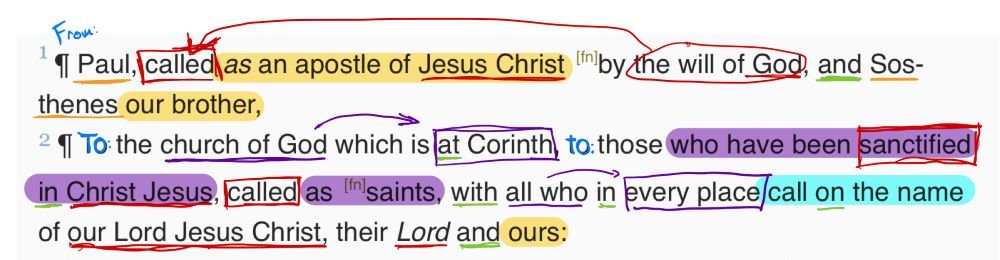
This letter starts with one of Paul’s standard letterheads. Typical of Paul’s writings is the statement of who the letter is from. In this case, the letter is from Paul and Sosthenes “our” brother. The word “our” implies that Paul is writing to someone who is of the same group as Paul. The word “brother” shows that Sosthenes shares a familial relationship with this group.
An apostle by the will of God
Paul says he is “called as an apostle of Jesus Christ, by the will of God.” The word “apostle” is a Greek word which means “sent forth” or “messenger.” Paul is an apostle “of” Jesus Christ. The word “of” could mean from, as in he is a “messenger from Jesus;” or “of” could mean about, as in “Paul is a messenger sent forth to tell about Jesus.” The fact that Paul is called “by the will of God,” shows that it’s not by his own will or effort, but rather the will of the higher power of God that he occupies this role.
Verse 2: To the Believers in Corinth
In continuing the letterhead, the author indicates to whom the letter is addressed. In this case, it’s addressed to the Church of God at Corinth, which is described as “those who have been sanctified in Jesus Christ.”
This second part strikes me as being similar to the way some letters of official business are addressed in modern times like the following, where the business is where this is going, but it’s specifically sent to the “ATTN:” personnel:
To: ATTN: So-and-So
XYZ Business
So this letter is being addressed to the Church of God at Corinth, but specifically to “those who have been sanctified in Christ Jesus, called as saints.”
These Corinthians have already been sanctified
What stands out to me is that these “have been” sanctified, as opposed to “are being,” or “will be” sanctified. “Have been” is past tense, implying that the sanctification of these people happened in the past instead of being an ongoing process or a future event. What’s more, this sanctification is “in Christ Jesus,” not in themselves. So Christ is the one who is sanctified, and they are in Christ, and therefore they are sanctified in Christ.
The word “sanctified” means to be set apart, or declared as Holy. Clearly, this holiness is not of themselves, but rather, they are sanctified in Christ, so any holiness would also be in Christ. This is found in other passages where our blessings are “in Christ.”
They were called as saints
Another point in the past tense is that those being addressed are “called as saints.” Note that it’s not that they will one day be saints, but that they have already been called as saints.
“As saints” could have a couple of meanings:
- First, they were already saints when they were called;
- Second, they became saints when they were called, “as” meaning “to be.”
Seeing that they are those “who have been sanctified,” I find it likely that their sainthood is tied to their sanctification, especially since the word for saint is the same Greek word as “sanctified” and both can be translated as holy one, set apart and also Holy. To follow the fact that they “have been sanctified” with them being “called as saints” is likely a restatement to bring further emphasis to their state in Christ as those that are set apart
With all in every place
The next clause says “with all who in every place call on the name of our Lord Jesus Christ, their Lord and ours.”
This could be saying one of two things:
- Those listed above, the church at Corinth, who have been sanctified and called saints, are called that ALONG WITH all “who in every place call upon the name of our Lord.
- This is another addressee of the letter. This letter is addressed to BOTH the Church at Corinth AND ALSO “all who in every place call upon the name of our Lord.”
Paul says that Jesus is “their lord and ours,” which seems to indicate that option one from above is the case, as it speaks of Jesus as “their” Lord as if they are not the ones being spoken to directly in this letter. His usage of “their Lord” implies that this is written directly to the church at Corinth, since if it was written also to those referred to as those “who in every place call upon the name of our Lord,” then he would have left it at that and there would have been no need for “their Lord and ours” at the end.
Conclusion
So then, in these first two verses of 1 Corinthians chapter 1, Paul addresses the letter from himself, as an apostle of Jesus Christ, and Sosthenes, to the Church at Corinth. He begins by saying that they are sanctified in Christ, called saints, just like all those who in every place call upon the name of our Lord Jesus Christ.
Related articles:
New
[showdpt instance=”3″]




Love it, thanks for sharing 😊