
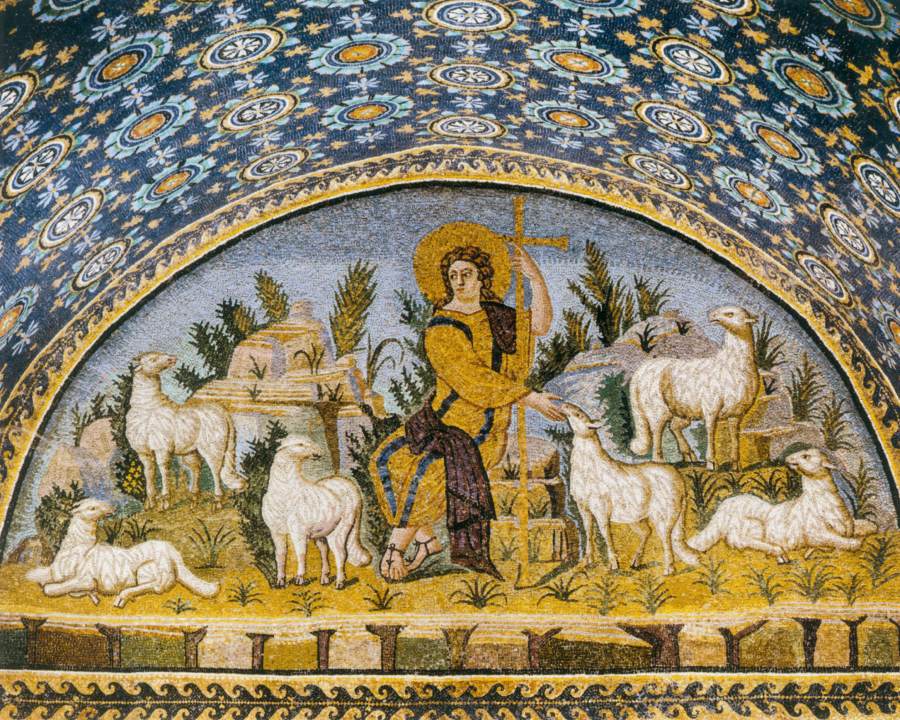
Jehovah’s Witnesses (JWs) love to use John 10 to argue that Jesus denied being God.
But what if I told you that this very passage actually refutes their claim and exposes a major contradiction with their theology?
You’ve probably had Jehovah’s Witnesses come knocking on your door at least once. If you haven’t, then just wait. I’m sure they’ll pay you a visit sooner or later.
Some say the Jehovah’s Witnesses are a cult.
Their teachings, as innocent as they may seem at first, have entrapped many people, separating them from family and friends, and keeping them entrenched in the false gospel of a works-based salvation.
As Christians, it’s important that we prepare ourselves not only to defend against their dangerous beliefs, but also to have a response ready for the topics that they’ll bring up with the hopes of planting seeds that will hopefully someday lead these people out of the cult they’re in.
Below, I’m going to show you what Jehovah’s Witnesses believe about John chapter 10, what it’s actually saying, and how we can respond to our JW friends when they bring up this scripture.
What Jehovah’s Witnesses Believe About John 10
Jehovah’s Witnesses rely on John 10 to claim that Jesus Himself refutes the accusation that he claims to be God.
But what they don’t realize is that John 10 actually disproves their own argument and highlights a major issue with their translation of the Bible.
When Jehovah’s Witnesses knock on your door, one of the most common topics that will come up is the deity of Christ.
The deity of Christ is super important. Some say it’s the difference between Him being able to fully bear our sins or not, and whether he can rightfully receive worship as he does at several points in the New Testament.
JWs Deny The Deity Of Christ
Jehovah’s Witnesses strongly oppose the deity of Christ. They rightly believe there is only one God. But they often conflate Oneness or Modalism with the Trinity. So it can be hard for them to see how Trinitarians can claim that there are three divine persons but only one God. This leads them to overemphasize any differences between the father and son and cite them as evidence that Jesus is not truly God.
Jehovah’s Witnesses Understand “god” Differently
In the discussion regarding the deity of Christ, it’s helpful to note that JWs have a slightly different view of what the word ‘god,’ with a lowercase ‘g’ means. To a Jehovah’s Witness, there are different categories of god. The way they see it, there is one true God who is almighty and all powerful. But there are also those who are called gods due to their positions of power or authority.
An article from JW.org titled “Is Jesus Christ God” provides a great explanation of how they view it.
They cite 2 Corinthians 4:4 as evidence that angelic powers are called gods and they point to several historical figures who are called gods either by themselves or by others. They claim that the Bible supports this characterization of them in 1 Corinthians 8:5 where Paul says there are many gods.
Understanding how JW’s view the term God is essential to discussing John 10 with them. Jehovah’s Witnesses are notorious for pulling verses out of context. In the case of John 10, they’ll pull out verses 34-36.
The Jehovah’s Witness View of John 10
Let’s take a look at John 10 in the New World Translation:

Again, the goal of Jehovah’s Witnesses is to use this verse as evidence that Jesus refutes any accusation that He claims to be Almighty God.
In conversation, they’ll bring this up and say something like: “See, so Jesus claims that he’s God’s son, not God Himself.” They’ll point out that Jesus is saying this in response to the accusation which the Jews bring against Him in verse 33.
What seems to help their claim is the fact that several things in this passage are different than they are in most other Bible translations. Most notably, verse 33 has the Jews accusing Jesus of making Himself “a” god.
Now that we understand how Jehovah’s Witnesses view this passage, let’s look at how you should respond when they bring it up.
Again, Jehovah’s Witnesses don’t realize that this actually says the opposite of what they think it does, and it highlights a major theological issue with their New World Translation.
Point #1: Jesus doesn’t refute anything
The first thing we should do when they bring this up is ask the Witness to show us specifically where Jesus refutes the charge the Jews accuse Him of.
This might sound a bit basic, but the refutation that JW’s claim Jesus is making simply isn’t there.
They, and others who deny the deity of Christ, often make the claim that there are numerous opportunities for Jesus to come out and say something like: “I am God.” But he never explicitly makes that claim. Since he never clearly proclaims it, they say this is evidence that he isn’t God. However, the same could be said for the complete opposite argument.
Jesus never clearly refutes the accusation that He claims to be God.
If ever there was a time to come out and say, “Hey guys, I’m not God.” This would have been the time. But he doesn’t say that either.
Here, in John 10, he is being directly accused of making that claim.
Where is His clear refutation?
This puts the pressure back on the Jehovah’s Witnesses to prove their point
Pointing this out turns their own argument back against them and they won’t know what to do with it. Asking them to show you exactly where Jesus refutes the Jews accusation will put them off balance and likely ignite a mad scramble to change the subject.
So, you need to act quickly with a second point.
But before we get there,
We Need To Look At Some Broader Context.
In verse 34, Jesus quotes Psalm 82. So, let’s take a look at that.
Psalm 82
God comes to the “gods” in verse one. We see that He has great displeasure with their actions.
They judge unrighteously and show partiality to the wicked. Instead, they ought to give justice to the poor and the orphan. They ought to justify the afflicted, protect the poor and needy, and deliver them out of the hand of the wicked.
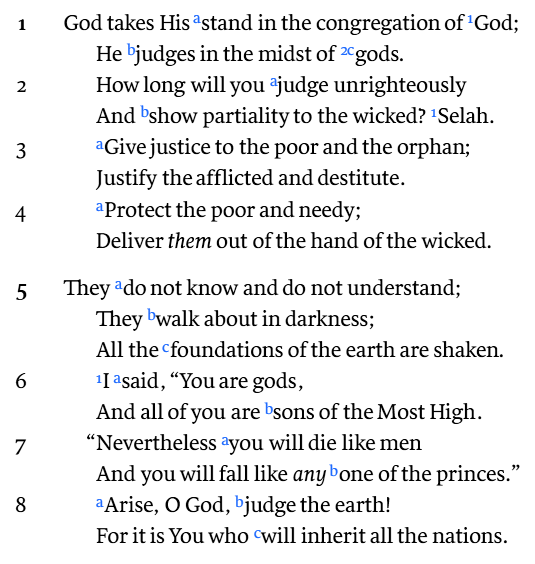
With the Witness still reeling from that last question we posed, point out to them that Jesus is quoting Psalm 82. In the Psalm, Jehovah comes to these “gods” and expresses his frustration with them.
Point #2: Jesus is comparing and contrasting Himself
Jehovah’s Witnesses like to say that Jesus is pointing out men who were called “gods” in the Old Testament in order to show the Jews that it wouldn’t be too outrageous if He, a man, were also called “a god.” But they misinterpret His words. In John 10, Jesus is actually drawing a distinction between Himself and those “gods,” and in doing so He’s making a comparison that Jehovah’s Witnesses don’t see.

As you can see, in verses 35-36, He points out that the “word of God” came to the “gods.” Then he points out to them the He is the one whom “the Father sent into the world.” In doing this He compares Himself to “the word of God” and Contrasts Himself with the “gods” that the Word came to.
But wait.
Who is it that comes to the “gods” in Psalm 82?
Jehovah’s Witnesses say it is Jehovah, the Almighty God, who comes to them in judgement.

Jesus Compares Himself With God
The interesting thing about this is that, up until this point, Jesus has been criticizing the Pharisees and the Jews in much the same way as Jehovah criticized the “gods” in Psalm 82.
Jehovah criticizes the “gods,” who are imperfect rulers, for their injustice and partiality. He accuses them judging unjustly, showing partiality to the wicked, not defending the weak, and allowing the wicked to exploit and harm the lowly.
Jesus criticizes the Pharisees, who are also imperfect rulers, of similar evils. They prioritize traditions over truth in scripture. They place unnecessary burdens on people. They neglect justice, mercy and love for God, choosing instead to focus on trivial details of the law. He accused them of being legalistic and hypocritical and He condemned them for their behavior.
Jesus also picks up the quote from Psalm 82 at a particular point. He says: “I said, you are gods.” Of course, that may be just another strange coincidence that makes it seem like He is identifying Himself as Jehovah.
In this comparison, He seems to be identifying Himself as Jehovah, the God who came to judge in Psalm 82.
In His response to them, He’s actually showcasing the thing he said before, that He and the Father are one.
Pointing This Out To Them Is Valuable
Getting Jehovah’s Witnesses to realize that Jesus is actually making a much grander claim will make them think twice about this in the future and hopefully help them to see that the Watchtower is grasping at straws here.
Clearly, Jesus is not refuting anything the Jews are accusing Him of. He’s actually doubling down and claiming to be something greater than what the Jehovah’s Witnesses think He is. The Jews realize this, they don’t take his words as a denial or refutation to their accusation. Instead, they tried to seize Him.
Since this seems to be a go-to argument for the Jehovah’s Witnesses, these scriptures just became a valuable tool for the Bible believing Christian trying to share the gospel with them.
* Just as a quick side note, I recognize that neither of these two points will prove the deity of Christ to the Jehovah’s Witnesses. John 10 does provide some compelling points to that end elsewhere, and I’ve decided to save that for another post, which will have a more in-depth look and a more in-depth look at the rest of this chapter. If you’re interested, then click the link in the description or subscribe and hit the bell to be notified when I release it. *
A Bigger Problem For Jehovah’s Witnesses
These verses, and the Jehovah’s Witness doctrine based on them, show a major problem with their Bible of choice, the New World Translation and the Watchtowers teaching.
Now, let’s get something straight here. The New World Translation, which I’ve quoted several times in this post, is a very biased translation. The only reason I recommend being familiar with it is precisely for times like this when Jehovah’s Witnesses come knocking on your door and they want to talk about theology. Most of the time, they’ll only pay attention to their own materials, and including their own Bible.
Not everything in the New World Translation is wrong. Some of it is translated just fine. But knowing where the huge errors are can be really useful.
Jehovah’s Witness Interpretation Highlights a Contradiction in Their Theology
For example, in the case of John 10, JWs make the claim that Jesus is refuting the accusation of the Jews, which they bring in verse 33, where they accuse Him of making Himself “a god”. Those of you following along in your own Bibles might notice a glaring difference right there. The New World Translation says “a god,” whereas any normal Bible just says “God.”
That’s not the only place this happens. And one place in particular presents a difficult challenge for the Jehovah’s Witnesses.
In John 1:1, a normal Bible says, “The word was God.” But the New World Translation says, “The Word was a god.”
Show this to them.
Was Jesus a god? Or Not?
Jehovah’s Witnesses have no problem acknowledging that “the Word” in John 1 is Jesus. But this means that John 1:1 affirms that Jesus is a god according to their own Bible. If it’s the case that Jesus(being the Word) IS a god, then how is Jesus refuting a “false accusation,” as the Watchtower claims in their article “One With the Father But Not God.”
Which one is right?
The Watchtower says that Jesus is refuting the Jews false charge.
So ask the Witnesses this: Is John 1:1 correct in stating that Jesus is a god? Or is the Watchtower correct in calling that a false charge in John 10:33?
Obviously, this is a huge contradiction and will hopefully serve as one more straw on the camel’s back to opening our JW friends’ eyes to the error of the Watchtower’s teaching.
Recap and Conclusion
Okay, let’s recap our main points here.
- Jehovah’s Witnesses rely on John 10 as evidence that Jesus refutes the accusation or the claim that he is God.
- They say that he actually claims to be God’s son, and not a god Himself.
- When they bring this up, we should ask them specifically where he refutes the accusation of the Jews.
- While they’re contemplating this, remind them that Jesus is quoting Psalm 82, in which Jehovah confronts the gods who were appointed to be his servants.
- Then point out to them that Jesus is actually making a comparison in which he contrasts Himself with the “gods” in the Psalm, and likens Himself to the Word of God that came to them.
- Ask them: who was it that came to the gods, was it Jehovah, as the Watchtower claims, or the Word, as Jesus claims? And show them that Jesus is identifying as Jehovah, separate from the Father, but one in being God.
- At this point, its important to give them some breathing room and allow them to think about the questions you’ve asked them.
- If you get a chance, gently ask them about John 1:1.
- If John 1:1 claims that the Word IS a god, even according to the New World Translation, then why would the Watchtower teach that Jesus seeks to refute this accuation in John 10?
You probably won’t get an immediate admission of error.
And that’s okay.
What you’ve accomplished is valuable.
In bringing up these points to them, you’ve turned a section of scripture that they regularly depend on into evidence that supports the biblical position that Jesus is God. And every time they turn to it again, they’ll probably remember that.
You’ve also planted a seed in their minds that the Watchtower isn’t watching out for them. And maybe that will help bring them out of this cult eventually.
I had a lot of fun studying John chapter 10 and making this post. And I would love it if you could read John chapter 10 and tell me your thoughts in the comments below. If you found this helpful, please share it with others and subscribe to be alerted when add another post!



Leave a Reply